
When you share invoices from Abtrac to your accounting system, General Ledger (GL) account codes determine where the revenue from each invoice line is recorded in your accounts.
Abtrac can apply these codes automatically using your default GL account code and more specific coding rules for offices, job types, departments, tasks and disbursements. You can also manually change the GL code on an invoice or individual invoice line before sharing it with your accounting system.
How to add GL Account codes to Abtrac
This article explains how GL accounting codes are applied to invoices, rather than how to add or configure your list of available GL account codes. Before you begin, you can add codes from Accounting> Interface Settings > Settings > Manage GL Account codes.
More details are included in these articles:
Configuring the Accounts Interface to Xero
Configuring the Accounts Interface to MYOB
How Abtrac determines which GL account code to use
At its simplest, every invoice has a default GL account code associated with its Accounting Interface and Invoice Settings.

If you don’t require more detailed revenue coding, this may be the only GL account code you need. For example, all fee revenue might be allocated to your standard Sales or Consulting Revenue account.
If your accounting requirements are more detailed, you can create rules that allow Abtrac to apply different GL codes according to the work being invoiced.
GL account codes can be associated with:
- Office + Department
- Job type
- Task
- Disbursement type
The code ultimately applied to an invoice line depends on the information associated with the project and the way the invoice lines are created.
GL account code hierarchy
Abtrac starts with your default revenue account code and then applies more specific coding where applicable.
A useful way to think about the hierarchy is:
Default GL code → Project coding → Invoice line coding → Manual override
1. Default GL account code
Your default GL code is the starting point.
It is linked through your Accounting Interface and Invoice Settings and provides a fallback account code for invoice revenue.
For many businesses, this is simply a general Sales or Fee Revenue account.
If no more specific coding rule applies, the invoice uses this default.

2. Project-based GL coding
More specific GL codes can be determined from information associated with the project, including:
- Office
- Job type
- Department
For example, your business might use separate revenue accounts for Surveying and Engineering projects, or separate accounts for different offices.
GL Code Mapping rules allow the appropriate account code to be selected according to these project classifications rather than using the general default.

3. Task GL codes
GL account codes can also be assigned to individual project tasks.
This is useful when different types of work within the same project need to be reported against different revenue accounts.
For example, a project could contain:
- Surveying
- Planning
- Engineering
If these tasks have their own GL account codes, Abtrac can use those codes when creating the corresponding invoice lines.
Task coding works particularly well where invoices are itemised by task, as the relevant task GL code can be applied to the invoice line as it is generated.

Read more about project tasks here
4. Disbursement GL codes
Individual disbursement types can also have their own GL account codes.
This is useful when recovered disbursement costs need to be reported separately from professional fee revenue.
For example, you might want professional fees allocated to your normal Sales account, while Property Search recoveries are allocated to a separate Disbursement Recoveries revenue account.
When disbursements are collated or itemised by disbursement type on an invoice, Abtrac can apply the GL code associated with that disbursement type to the relevant invoice line.
Important: The GL account code assigned to an invoiced disbursement represents the revenue or recovery being invoiced to your client. It is not the expense GL code used when the original cost was incurred.
Read more about Disbursement types here
5. Invoice and Invoice Line GL Codes
Although automatic coding is applied when an invoice is created, the codes applied to invoices and invoice lines can be edited manually.
The code for the invoice overall, and for all lines created for an invoice, is set withing the invoice management page, within the invoice header details.
Individual invoice lines inherit the GL Account code from the invoice header, these can codes be edited for individual invoice lines from the Edit Invoice pop up.
Invoice generation affects which codes can be applied
How your invoice lines are generated is important.
The process starts with your default GL account code, then uses more specific office, job type or department mappings, followed by task and disbursement codes when invoice lines are created.
When you use Abtrac’s automatic invoice generation options, the structure of the invoice determines which specific GL codes can be carried through.
For example:
- Itemise by task allows task-specific GL codes to be applied.
- Collate or itemise by disbursement type allows disbursement-specific GL codes to be applied.
- Where there is no more specific invoice-line code to use, Abtrac falls back to the applicable project or default GL coding.
This means two projects can use the same default revenue account but still produce invoice lines with different GL codes according to the tasks or disbursements being billed.
Manually changing GL Codes on an invoice
Automatic coding doesn’t prevent you from making changes to an invoices GL account code.
Before an invoice is committed and shared with your accounting system, you can review and manually change the GL account code if required.
You can change the code:
- For the invoice as a whole, where appropriate; or
- On individual invoice lines, allowing different parts of the invoice to be posted to different accounts.
Editing the GL code for all lines on an invoice
The code for the invoice overall, and for all lines created for an invoice, is set withing the invoice management page, within the invoice header details. Update the GL Account code for an invoice (an optionally all the lines within an invoice) from the Invoice Details tab.

Editing the GL code for a selected invoice line
Individual invoice lines inherit the GL Account code from the invoice header.
But, these can codes be edited for individual invoice lines from the Edit Invoice pop up.
Within an invoice > click on ‘Invoice Lines, Narratives and Amounts’ > click on the pencil edit button for any invoice line and the ‘Create/Edit Invoice Line’ box appears.

The required ‘GL Account Number’ can be selected from the dropdown menu, if different from the default.

Checking GL Codes assigned to invoice
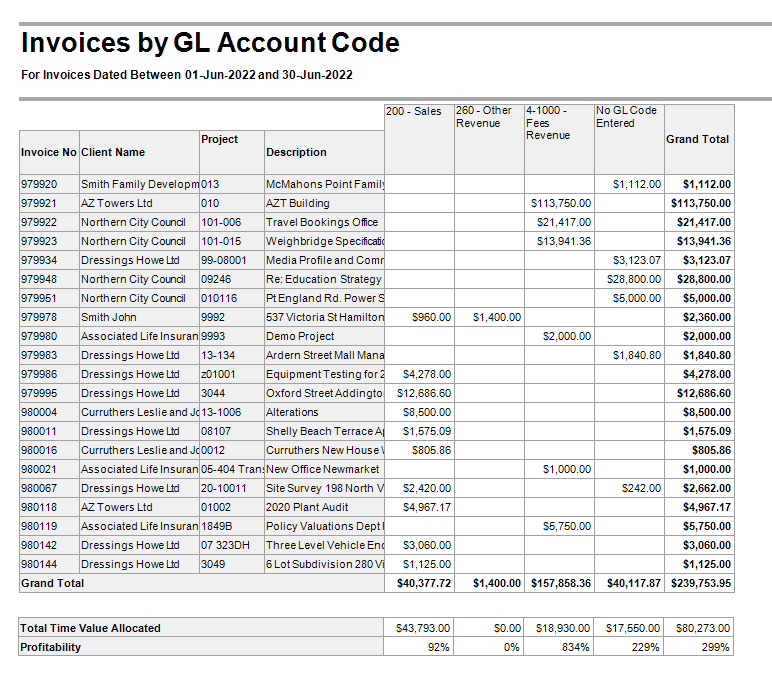
If you use complex coding in your accounts, we recommend reviewing your GL codes as part of your normal Abtrac invoice checking process. You can do this with the Invoices by GL Account Code report.
Once the invoice is complete:
- Check the GL account codes applied to the invoice and its invoice lines.
- Make any manual changes required.
- Commit the invoice.
- Include the invoice in your accounting upload batch.
- Share the invoice with your accounting system.
The GL account codes attached to the invoice lines are then transferred with the invoice for accounting and financial reporting.
View the Invoices by GL Account Code report here
Abtrac KB# 2198