
The Aged Debtors by Invoice report provides a detailed breakdown of outstanding debtor balances at the individual invoice level. Unlike the Aged Debtors Report, which summarises outstanding balances by client, this report lists each unpaid or partially paid invoice separately, allowing you to identify exactly which invoices are overdue and how long they have been outstanding.
Invoices are grouped into ageing periods based on the invoice date, helping you monitor overdue accounts, track payment performance, and prioritise debtor follow-up activities. The report can be run as either a 3-month or 6-month ageing analysis and can be filtered by office, job, and invoice status.
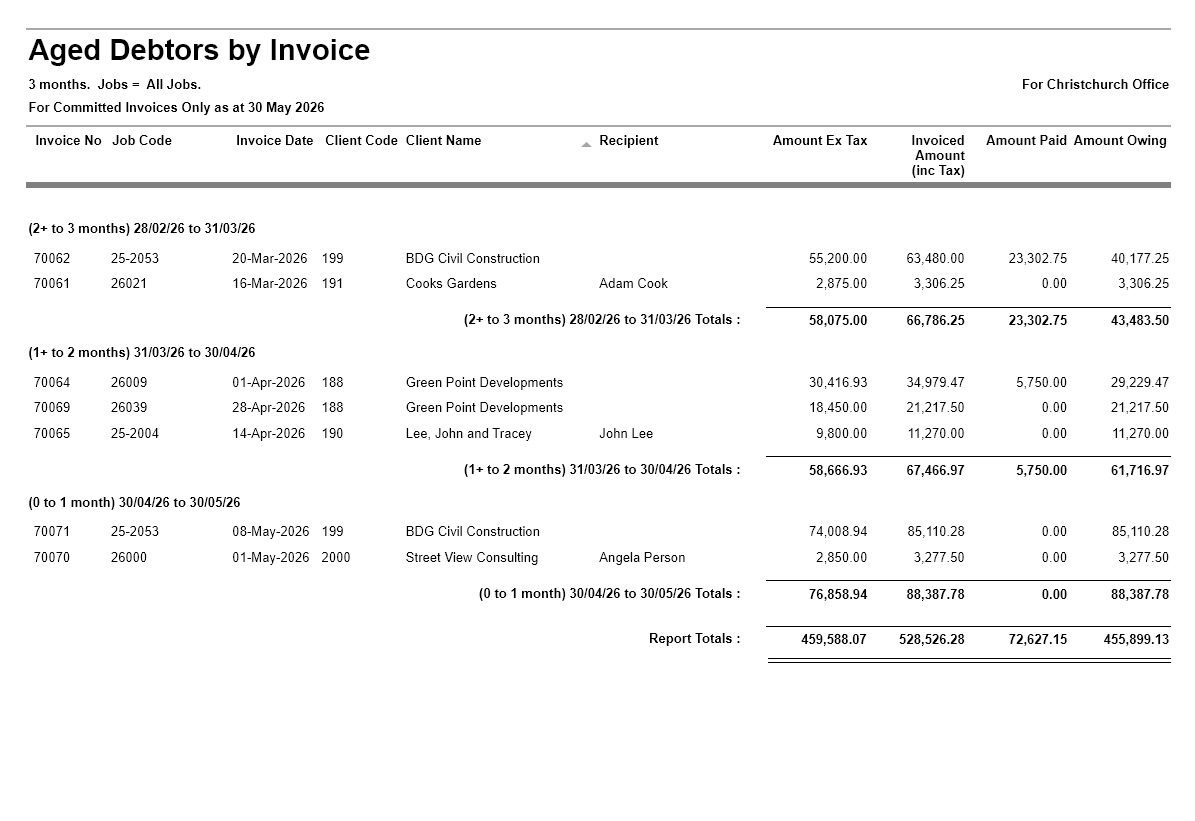
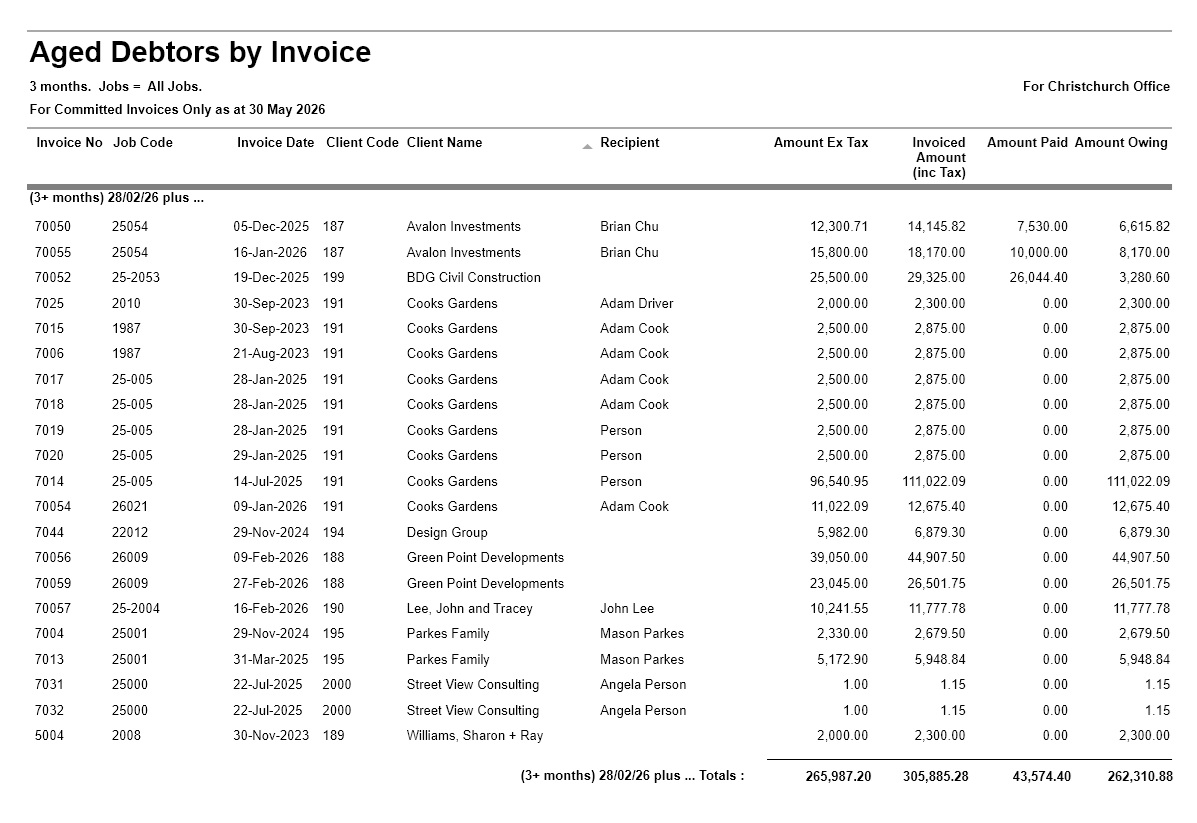
Aged Debtors by Invoice Report
This report is particularly useful for identifying overdue invoices that require follow-up, analysing how outstanding debt is distributed across ageing periods, and investigating debtor balances in greater detail than the summary Aged Debtors Report.
Go to Debtor Management >> Debtor Reports >> click on ‘Aged Debtors by Invoice’ then select any filter options. You can set the date range, and aging period in the next step.
Aged Debtors by Invoice Report – Filter, Sort and Grouping Options
You can also optionally filter, and group this report by Invoice Office, Job Team, Client Owner, and Job Owner 1, and filter by Client and Job Owner 2.
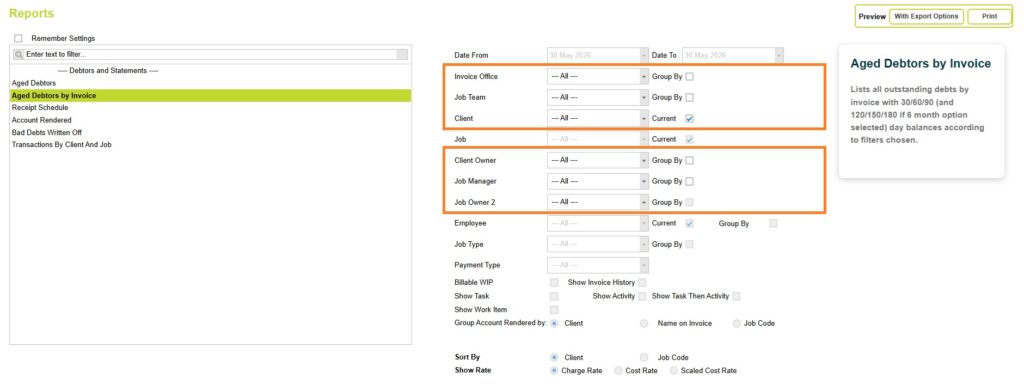
Now click on the Preview button and select one of the preview options (Print or with Export options).
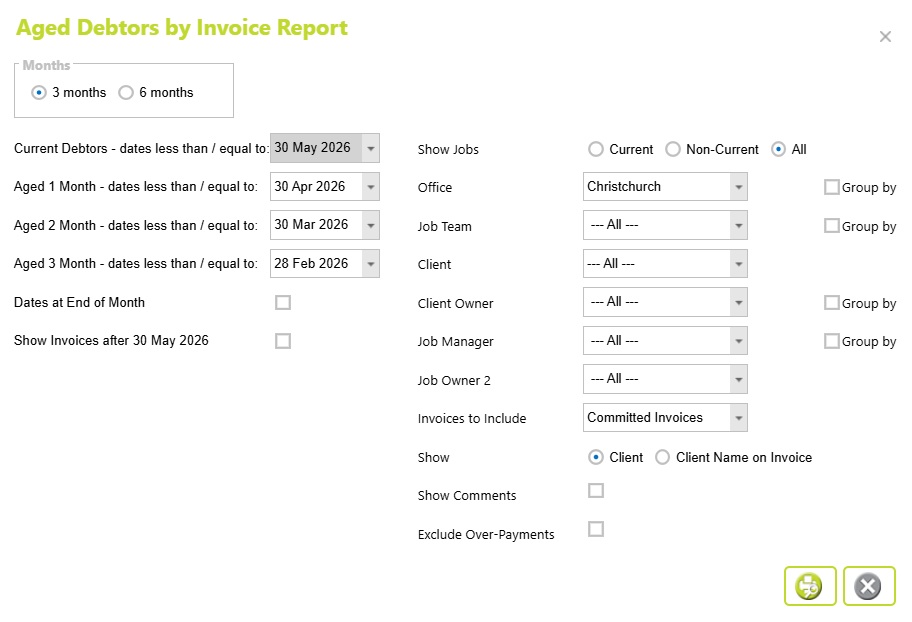
Next, select your date range and any additional report options.
You can run the report using either a 3-month or 6-month ageing analysis and, if required, calculate ageing based on month-end dates.
The same filtering options available from the main Reports menu are also available here. In addition, you can choose which invoices are included in the ageing calculation, such as All Invoices, Committed Invoices only, or Uncommitted Invoices only.
You can also choose whether to display the Client Name or the Name on Invoice, exclude overpayments, and limit the report to current or non-current projects. If debtor comments have been recorded through Debtor Control, these can also be included in the report.
Click on the preview button to preview the Aged Debtor by Invoice report.
Understanding the data
The report lists each invoice with the amount, any payments and amounts owing.
Typical columns include:
- Invoice No
- Job Code
- Invoice Date
- Client Code
- Client Name
- Recipient
- Amount Ex Tax
- Amount (inc Tax)
- Amount Paid
- Amount Owing
The report is grouped into ageing sections. At the end of each section the report provides subtotal values showing – total invoiced amounts, total payments received, total outstanding balances.
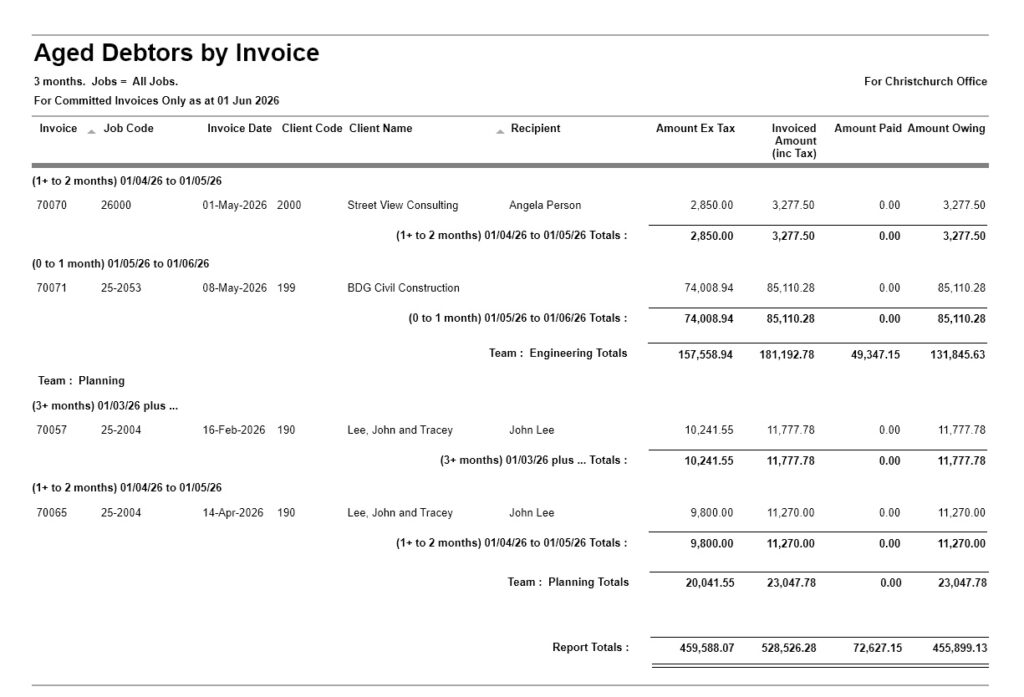
Grouping by Office or Team
When the report is grouped by Office or Team, invoices are organised into the following hierarchy:
- Office (or Team)
- Ageing Period (0–1 month, 1–2 months, 2–3 months, 3+ months)
- Individual Invoices
- Ageing Period Subtotal
- Office (or Team) Subtotal
- Report Total
This allows you to review outstanding invoices by office or team while still seeing ageing period subtotals and overall totals for each group.
Grouping by Client Owner, Job Owner 1, or Job Owner 2
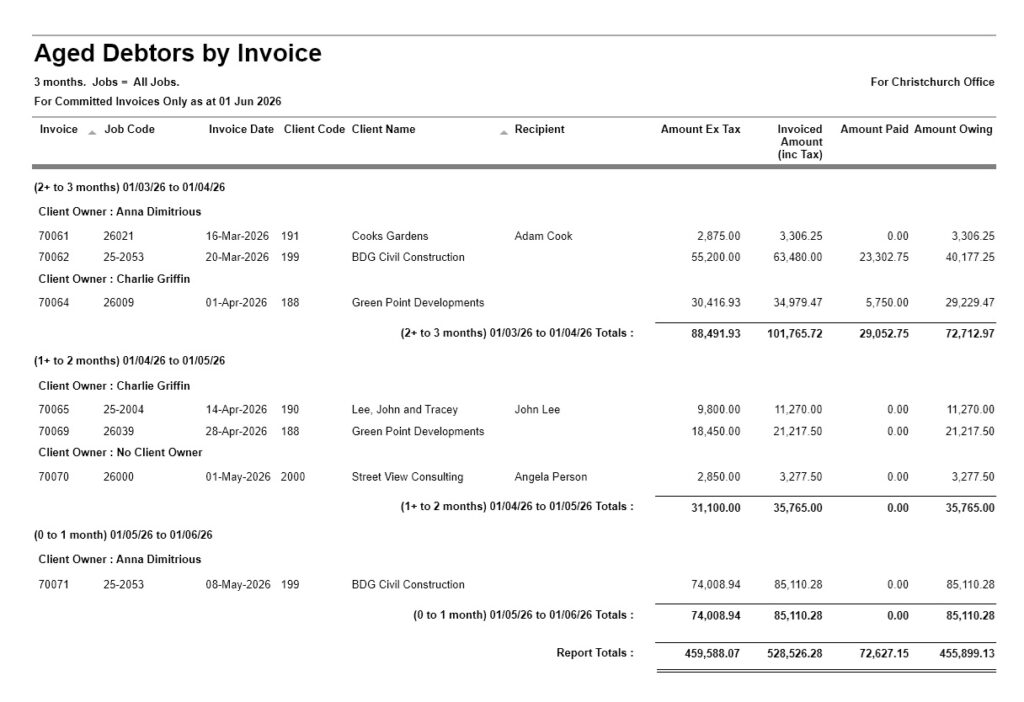
When grouped by an owner field, the report structure is slightly different. Owners are displayed as headings within each ageing period rather than as separate report sections.
The report is organised as follows:
- Ageing Period (0–1 month, 1–2 months, 2–3 months, 3+ months)
- Owner Grouping (Client Owner, Job Owner 1, or Job Owner 2)
- Individual Invoices
- Ageing Period Subtotal
- Report Total
Unlike Office and Team groupings, the report does not produce separate subtotals for each owner. The owner headings are provided to help identify responsibility for outstanding invoices, while totals continue to be calculated only at the ageing-period and report levels.
How ageing periods are calculated
Ageing periods based on the invoice date. The report uses a selected “as at” date to determine which invoices fall into each ageing category.
For a 3-month report run as at 30 May 2026:
| Ageing Category | Report Section Name | Description | Invoice Date Cut-off |
| Current Debtors | (0-1 month) | Outstanding invoices that fall within the current ageing period | Invoices dated between 30 April and 30 May 2026 |
| Aged 1 Month | (1+ – 2 months) | Outstanding invoices aged one month | Invoices dated between 30 March and 30 April 2026 |
| Aged 2 Months | (2+ – 3 months) | Outstanding invoices aged two months | Invoices dated between 28 February and 30 March 2026 |
| Aged 3 Months+ | (3+ months) | Outstanding invoices aged three months or more | Invoices dated on or before 28 February 2026 |
These cut-off dates are automatically calculated based on the report date and selected ageing period.
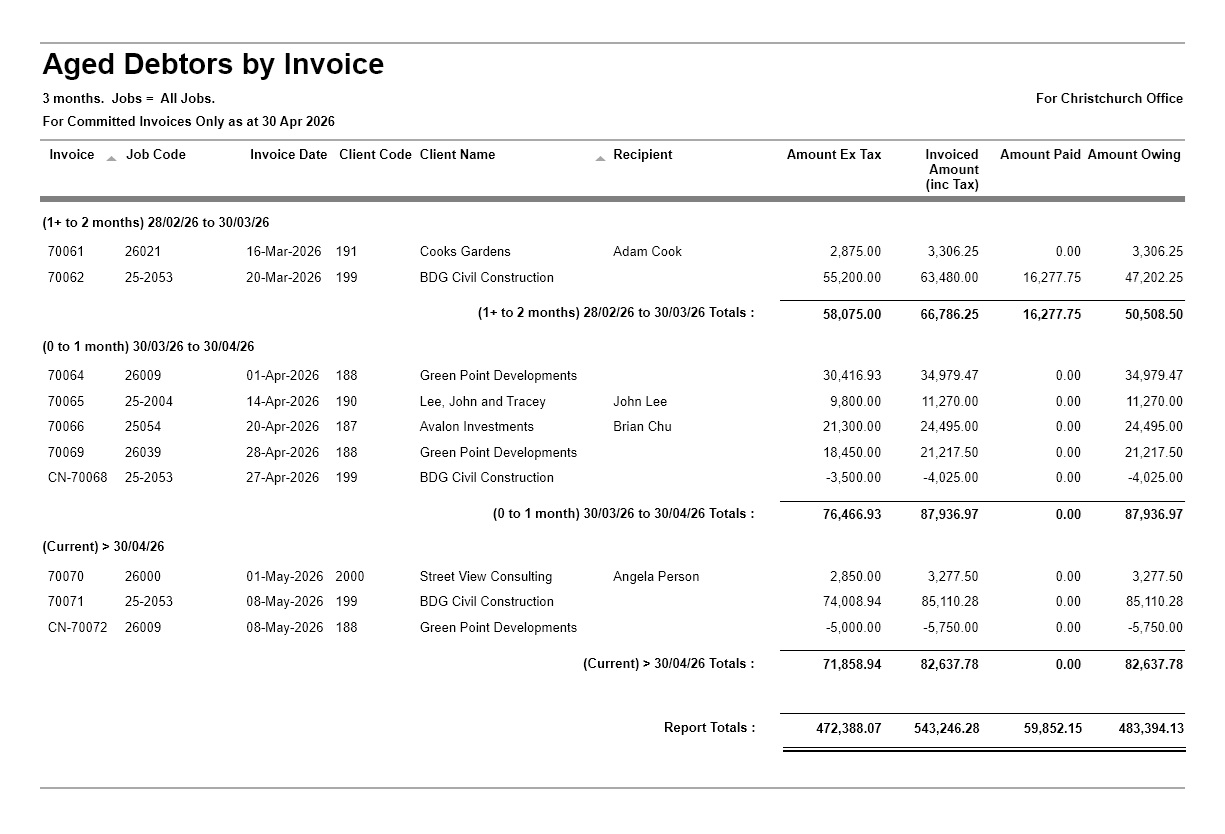
Show Invoices after the current debtors date
Show Invoices after Current Debtors Date adds a Current section to the report, displaying invoices raised after the selected debtors date. These invoices are separated from the aged balances, allowing you to view recent invoicing activity alongside the historical ageing analysis.
For a 3-month report run as at 30 May 2026:
| Ageing Category | Report Section Name | Description | Invoice Date Cut-off |
| Show invoices after ‘the current date’ | Current > report date | Invoices dated after the As At Date (only displayed when Show Invoices after Current Debtors Date is enabled) | Invoices dated after 30 May 2026 |
Comment
If debtor comments have been recorded through Debtors Management > Debtor Control > Edit Debtor Details, these can also be included in the report, by selecting Show Comments in the report options before previewing.


Invoiced Amount (Incl Tax)
The invoiced total including tax, for the selected invoice.
Amount Paid
The total of any recorded payments for the relevant invoice, including tax. This will balance to data in the Paid column in the Debtor Control page. This is also visible within the Record Payments pop up on the Invoices and Payments page.
Amount Owing
The total outstanding balance for the relevant invoice, including tax. This will balance to the Still Owing (Overpaid) amount on the Invoices and Payments page, and the Balance amount on the Debtor Control page.
Abtrac KB # 2257